Putting the Five-Planet Gathering Back in the Sky: Revisiting 967 CE
The Rizhi Lu records five planets gathering near the Kui lunar mansion in 967. We reconstruct the event in Totenroku and separate the astronomy from its later political meaning.
In “The Gathering of the Five Planets,” Gu Yanwu’s Rizhi Lu reads like an index of unusual skies, collecting records from the Zhou through the Ming. Its entry for the early Song is only one line:
In the third month of the fifth year of Qiande, under the Song, the five planets gathered in Kui.
The History of Song adds a visual detail: the five planets appeared “like a string of pearls” around the adjacent Kui and Lou lunar mansions. In the Common Era, this was 967 CE. It was not merely an auspicious tale confined to a chronicle: set a modern ephemeris back by more than a millennium, and the planetary grouping returns to the sky map.
What were the “five planets”?
They were the five naked-eye planets known in classical China: Mercury (Chenxing), Venus (Taibai), Mars (Yinghuo), Jupiter (Suixing), and Saturn (Zhenxing).
They were not physically close in space. A “gathering” meant that, as seen from Earth, their apparent positions occupied a relatively small region along the ecliptic. Their orbital periods differ enormously, so bringing all five moving lights into the same part of the sky is uncommon. “Like a string of pearls” is best read as an observational image, not as a claim of a mathematically perfect line.
Kui and Lou are neighboring members of the twenty-eight lunar mansions. Kui’s sixteen traditional stars lie across parts of the modern constellations Andromeda and Pisces. Chinese astronomers used mansions and asterisms as a coordinate language for tracking the Sun, Moon, and planets; “gathered in Kui” therefore describes a location on the celestial sphere, extending in this account toward neighboring Lou.
Returning to 967 in Totenroku
In our test, we set Totenroku’s date dial to 3:59 a.m. on May 9, 967, then opened the AR stargazing view.

The screen also resolves an easy calendrical misreading. The year 967 was Dingmao, not Bingchen. The four labels at the top are the year, month, day, and hour pillars; Bingchen is the day pillar in this screenshot.
Moving along the ecliptic in the stargazing view reveals the planetary group near Kui and Lou. Labels can overlap when the inner planets are especially close. The physical core of the historical report—multiple naked-eye planets crowding this region of the sky—is reproducible.
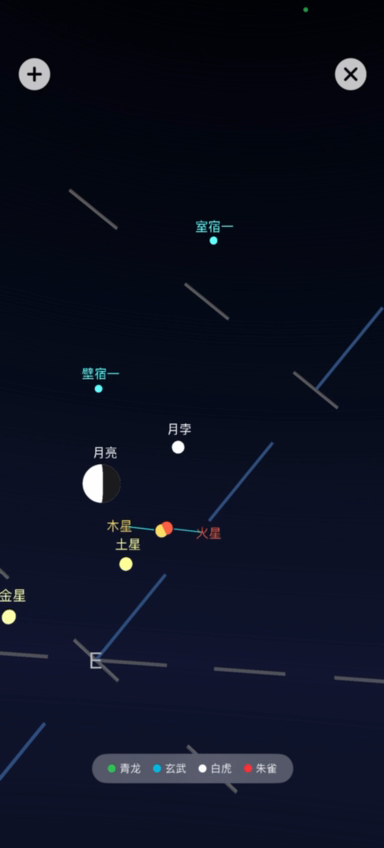
There is an important scholarly limit. The History of Song gives only the lunar “third month”; other sources specify its fifth day. Conversions can also differ between the Julian calendar and the proleptic Gregorian calendar. May 9 is the point selected in this App demonstration to make the grouping easy to inspect. It confirms the structure of the event in that historical period and sky region; it does not establish a single modern calendar date for every textual tradition.
How astronomy became a dynastic story
In premodern China, astronomy and omen interpretation were intertwined. After listing historical examples, the Rizhi Lu preserves a deliberately flexible prognosis: a virtuous ruler would receive blessings from such a conjunction, while an unvirtuous ruler might suffer the loss of state and ancestral temple. The same sky could therefore support opposite political readings.
Song writers later connected the 967 gathering with literary cultivation, the territorial correspondence of Lu, peace under heaven, and stories of Heaven’s mandate surrounding later emperors. A real planetary configuration became material for dynastic legitimacy.
The distinction matters:
- The configuration can be reconstructed with an ephemeris.
- The lunar-mansion terminology shows how early observers organized the sky.
- Its fortunate or ominous meaning belongs to historical and political interpretation.
We can confirm that the planets gathered in that sky without treating the event as a necessary cause—or prediction—of peace.
Making one sentence in an old book visible again
An old chronicle compresses weeks of celestial motion into four words: “five planets gathered in Kui.” Totenroku restores the missing time, direction, and sky. Choose a historical moment, enter stargazing mode, and the twenty-eight mansions, Sun, Moon, and planets return to one navigable celestial sphere.
The result is both an introduction to classical astronomy and a reading tool. When an old text says a body “trespassed,” “guarded,” “conjoined,” or “gathered,” put its date back into the sky before calling it a mysterious prophecy—and first see what the observer could actually have seen.